





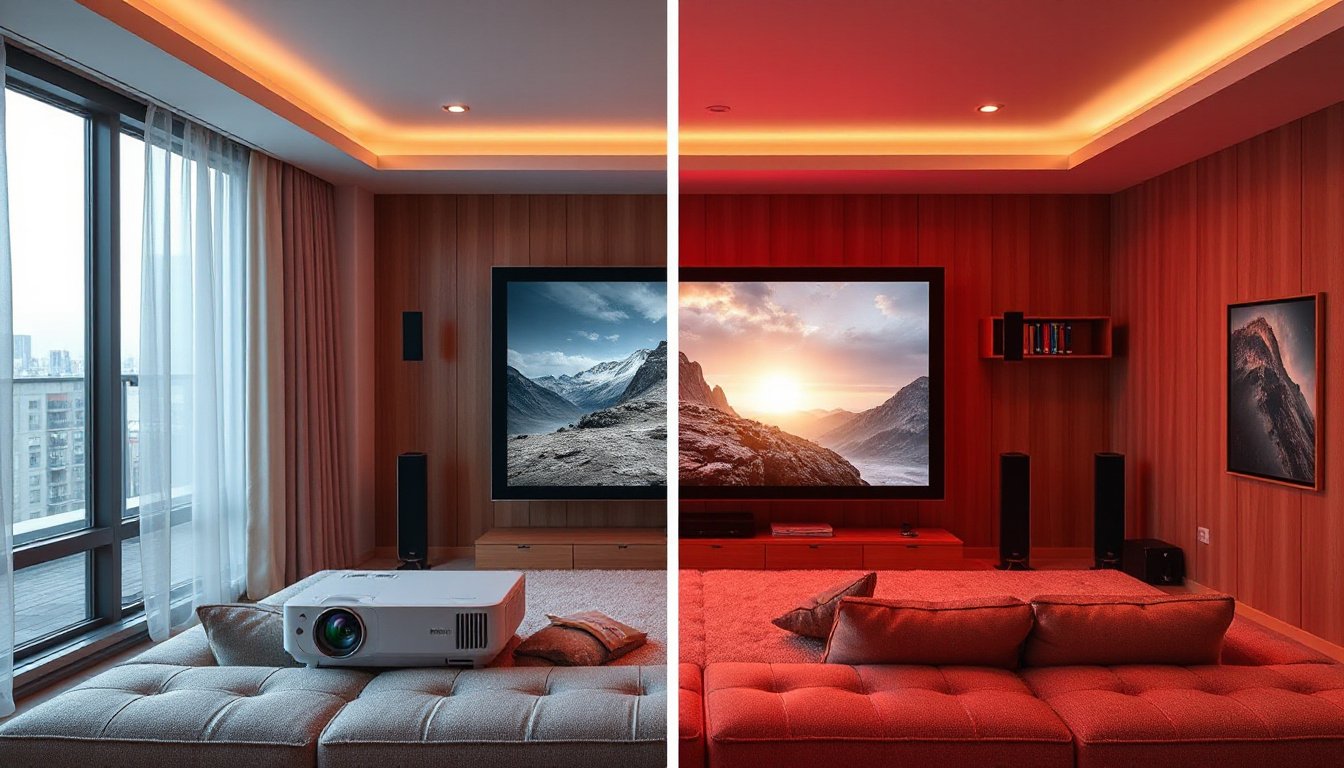
When setting up a home cinema, choosing the right projector is crucial to achieving the immersive viewing experience you desire. Two common specifications you’ll encounter are UHD (Ultra High Definition) and Full HD (High Definition) projectors. Understanding the differences between these two technologies will help you decide which projector suits your space, budget, and content preferences best. In this article, we explore the technical distinctions, benefits, and practical considerations of UHD vs. Full HD projectors.
Understanding the Basics: What Are UHD and Full HD?
Full HD (FHD) Projectors
Full HD refers to a display resolution of 1920 x 1080 pixels, totaling approximately 2.07 megapixels. It has become the standard resolution for televisions, Blu-ray players, and many projectors. Full HD delivers sharp images with good detail quality, suitable for most common viewing environments, especially on screens up to about 40 inches.
UHD (Ultra High Definition) Projectors
UHD, often synonymous with 4K, offers a resolution of 3840 x 2160 pixels—four times the pixel count of Full HD. This increase provides significantly more detail, clarity, and color depth. The higher pixel density of UHD projectors means images are crisper with finer textures, and they support advanced features like High Dynamic Range (HDR) for richer contrast and color accuracy.

Key Differences Between UHD and Full HD Projectors
| Feature | Full HD Projector | UHD Projector |
|---|---|---|
| Resolution | 1920 x 1080 pixels | 3840 x 2160 pixels (4× more pixels) |
| Pixel Count | ~2 million | ~8 million |
| Color Depth | 8-bit (approximately 16 million colors) | Up to 10-bit (over 1 billion colors) |
| Viewing Distance Suitability | Better suited for viewing beyond 6 feet or smaller screens (~40 inches and below) | Ideal for closer viewing distances and larger screens (>40 inches) |
| Bandwidth Requirement | Lower bandwidth needed for streaming and content playback | Higher bandwidth needed due to larger data size |
| Content Availability | Widely available HD content | Increasing UHD content availability but may require compatible sources |
What Does the Difference Mean for Your Viewing Experience?
Image Clarity and Detail
With UHD projectors offering four times the pixel count of Full HD, images appear significantly more detailed. This difference becomes particularly noticeable on larger screens and when sitting closer to the screen, as UHD’s higher resolution reduces visible pixelation, delivering a smoother and more lifelike picture.
Screen Size and Viewing Distance
If your home cinema setup involves a screen smaller than 40 inches or if you view the screen from a distance greater than six feet, Full HD projectors often suffice. However, for larger screens or when viewers sit closer to the image, UHD projectors provide a clearer and more immersive experience.
Color Reproduction and HDR Support
UHD projectors generally support a wider color gamut and higher color bit depth, enabling them to display richer and more nuanced colors. The support of HDR further enhances the dynamic range and realism of images, making UHD projectors superior for displaying modern content that uses these features.
Content Availability and Compatibility
Full HD content remains widely accessible, making Full HD projectors versatile for many uses. Nonetheless, the availability of UHD content, such as streaming services, UHD Blu-rays, and gaming, is growing rapidly. To fully enjoy UHD projectors, ensure that your playback devices and media support UHD resolution.
Practical Considerations When Choosing Between UHD and Full HD Projectors
-
Budget
- Full HD projectors are generally more affordable than UHD models.
- UHD projectors come at a premium but offer future-proofing for evolving content standards.
-
Room and Environment
- Consider the projector’s lumen rating (brightness) alongside resolution; a bright room requires a projector with higher lumens regardless of resolution.
- UHD projectors’ finer pixel density may require premium lenses and color processing.
-
Projector Features
- UHD models often include advanced features like HDR support, better contrast ratios, and superior color management.
-
Usage Types
- If you prefer watching UHD movies, gaming in 4K, or streaming HDR content, a UHD projector enhances your experience.
- For standard HD television, casual viewing, or presentations, a Full HD projector may be sufficient.
Summary: UHD or Full HD Projector — Which Should You Choose?
| Choose a Full HD Projector if: |
|---|
| – You have a limited budget |
| – Your screen size is under 40 inches |
| – You often sit far away from the screen (>6 feet) |
| – Your content is mostly available in HD format |
| Choose a UHD Projector if: |
|---|
| – You want the highest image quality and detail |
| – You have a larger screen (>40 inches) |
| – You sit close to the screen (<6 feet) |
| – You frequently watch UHD or 4K content with HDR |
| – You want to future-proof your home entertainment setup |
Investing in a UHD projector significantly elevates your home cinema’s visual performance, especially for large-screen setups and UHD content enthusiasts. However, Full HD projectors remain practical and cost-effective for everyday use, smaller rooms, and HD content consumers.
Final Tip:
For the best results, pair your projector choice with matching screen size, ambient lighting conditions, and quality source material. This will optimize your home cinema experience irrespective of resolution.
Whether you opt for UHD or Full HD, understanding these differences enables you to make an informed choice tailored to your home cinema needs. Choose wisely and enjoy your movies, games, and shows with the clarity and excitement they deserve.