





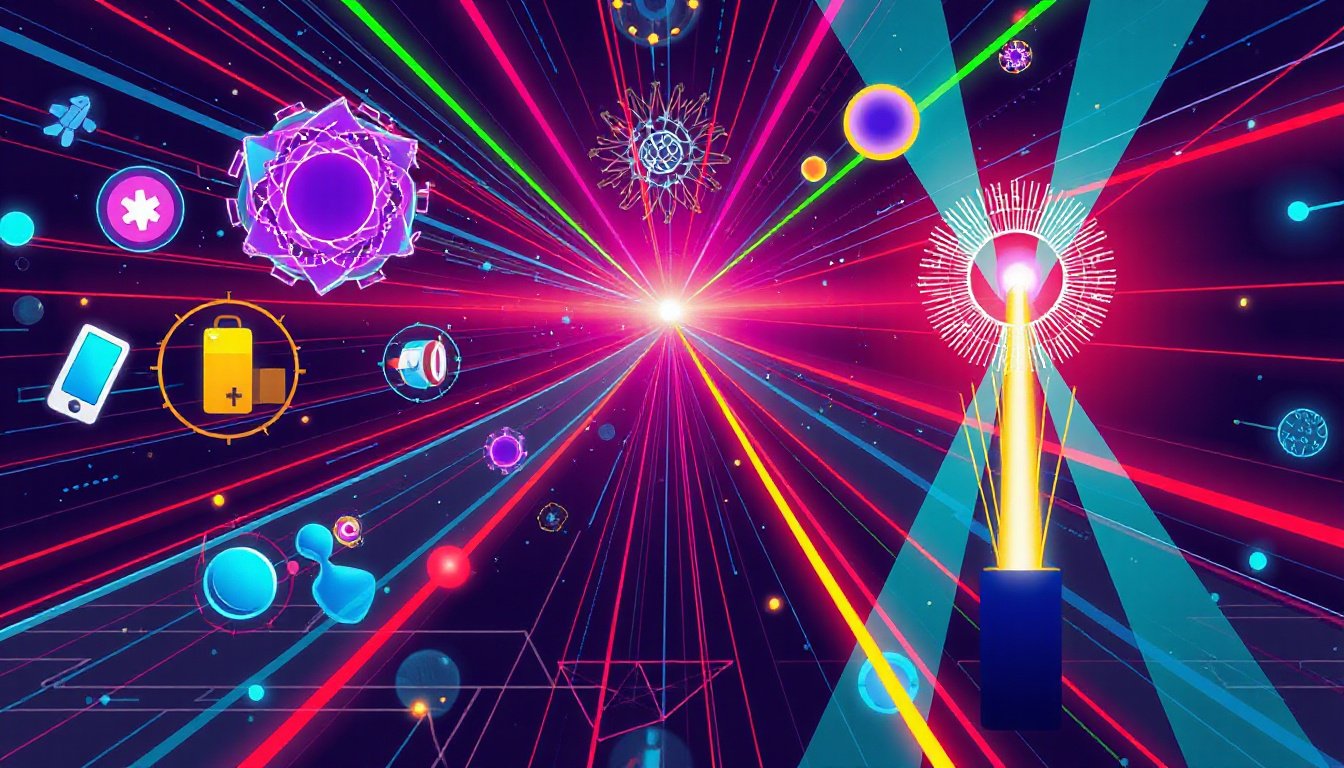
Lasers, an acronym for Light Amplification by Stimulated Emission of Radiation, are one of the most influential technologies developed in the 20th century. From their inception in the early 1960s to their widespread applications today, lasers have transformed numerous scientific fields and industries by offering unprecedented precision, power, and versatility. This article explores the fundamental principles of laser operation, their unique properties, and the groundbreaking applications that continue to drive innovation across various sectors.
Understanding the Fundamentals of Lasers
At the core of laser technology lies the process of stimulated emission, wherein electrons in atoms or molecules, excited to higher energy states, release photons (light particles) when they return to lower energy levels. Unlike ordinary light sources, such as incandescent bulbs that emit incoherent light spanning a range of wavelengths, lasers produce coherent light. This means the light waves are in phase spatially and temporally, resulting in a concentrated beam of a single wavelength or color.
Lasers consist primarily of:
- Gain Medium: The material (solid, liquid, or gas) where stimulated emission occurs, chosen for its ability to maintain excited states long enough to amplify light effectively.
- Energy Pumping Source: An external energy input (electrical current, flash lamp, or another laser) that excites the electrons in the gain medium.
- Optical Cavity: Two mirrors positioned at either end of the gain medium reflect photons back and forth, amplifying the light through repeated stimulated emissions until it exits as an intense, focused beam.
The interplay of these components enables lasers to produce narrowly focused light beams that can maintain their intensity over long distances, often used in applications where precision and control are paramount.
Unique Properties of Laser Light
Laser light exhibits several distinctive characteristics that set it apart from conventional light:
- Spatial Coherence: The beam can be collimated to a tight spot with minimal divergence, enabling focused high-intensity illumination.
- Temporal Coherence: The emitted photons have synchronized phases over time, allowing the production of ultrashort pulses with highly monochromatic qualities.
- Monochromaticity: Lasers often emit light at a single wavelength, although some types can produce multiple wavelengths or broad spectra.
These properties make lasers invaluable in both scientific research and practical applications.
Types of Lasers and Their Operating Principles
Various types of lasers exist depending on the gain medium and pumping mechanisms:
- Gas Lasers: Utilize gases like helium-neon or carbon dioxide; commonly used in scientific instrumentation and cutting materials.
- Solid-State Lasers: Employ crystals or glasses doped with rare earth elements; effective for high-power applications including medical surgery.
- Fiber Lasers: Use optical fibers doped with rare-earth elements to produce efficient and compact laser systems.
- Semiconductor Lasers: Compact lasers used in telecommunications and consumer electronics such as DVD players and barcode scanners.
- Dye Lasers: Provide tunable wavelengths based on organic dyes in liquid solutions; favored in spectroscopy.
Advancements continue in exotic laser types, including free-electron lasers capable of producing extremely high energies and short wavelengths.

Revolutionary Applications of Lasers
Lasers have been integrated into an astounding array of technologies, profoundly impacting sectors such as medicine, communications, manufacturing, defense, and space exploration.
Medicine and Surgery
Lasers provide unparalleled precision for delicate medical procedures. Techniques such as LASIK eye surgery reshape the cornea with micron-scale accuracy, while laser cutting and ablation enable minimally invasive operations with reduced recovery times. Dermatology and cosmetic treatments utilize laser light to target specific tissues for skin rejuvenation and lesion removal.
Communications and Data Storage
Optical fibers employ lasers to transmit vast amounts of data with minimal loss over long distances, underpinning the global internet infrastructure. Laser technologies also power optical disc drives, laser printers, and barcode scanners, facilitating efficient data storage, retrieval, and processing.
Manufacturing and Material Processing
Powerful lasers enable precise cutting, welding, etching, and lithography essential for semiconductor fabrication and industrial manufacturing. Laser cutting machines can slice through dense materials like metal and diamond with exactness unmatched by mechanical tools.
Scientific Research and Space Exploration
Lasers are pivotal in spectrometry, allowing scientists to analyze the chemical composition of materials on Earth and other planets. NASA’s Curiosity rover, for example, uses a laser spectrometer to study Martian rocks. Furthermore, lasers facilitate distance measurements with extreme accuracy, such as calculating the Earth-moon distance by timing laser pulses reflected off lunar surface retroreflectors.
Defense and Law Enforcement
Lasers serve in targeting, range finding, and directed energy weapons systems. Their ability to deliver focused energy rapidly makes them effective for both offensive and defensive technologies.
Entertainment and Displays
Laser light shows captivate audiences with vivid, dynamic visuals powered by precisely controlled laser beams. Advances in laser projection are improving the quality and efficiency of imaging systems.
Innovations and Future Directions
Cutting-edge research continues to push the boundaries of laser technology. The National Ignition Facility (NIF) exemplifies large-scale laser innovation, using high-energy pulses to simulate star-like conditions for fusion research, aiming to create sustainable clean energy.
Recent developments include ultrafast lasers emitting pulses measured in attoseconds (one quintillionth of a second), promising breakthroughs in observing and controlling atomic-scale processes. Fiber laser technology advances yield more compact, efficient, and powerful systems for widespread applications.
Conclusion
Lasers exemplify the fusion of fundamental physics and engineering ingenuity, unlocking capabilities that have reshaped modern science and technology. Their coherent, focused beams illuminate new frontiers—from healing human eyes to measuring cosmic distances and igniting fusion reactions. As laser technology continues to evolve, its transformative potential promises to accelerate innovation across scientific disciplines and industries, illuminating the path toward a brighter, more precise future.
References and further reading available from: Wikipedia Laser, NASA Space Place – What is a Laser?, National Ignition Facility – How Lasers Work